Showing posts with label south america. Show all posts

Monday, January 10, 2011

How to enter Bolivia (a guide for Americans)


Since Bolivia was on our travel itinerary from the beginning and Americans need a visa to enter Bolivia we were consistently anxious about crossing the border while we were in Chile.  The internet, for once, was absolutely no help.  The embassy website told us that we needed our Yellow Fever vaccination, the bloggers, the few who did write about entering Bolivia said theirs were never asked for.  We couldn’t figure out where to go to get it done so we decided to wing it vaccination wise and all other ways wise because we didn’t know if we would get the visa upon entry, if we could pay with a card, if there was going to be a lot of bureaucratic bs around it or if we needed a concrete exit ticket in order to get in.  So I’m writing this blog in case anyone who reads this ever goes to Bolivia or so that anyone searching for this on Google like I tried to do will possibly come up with some real information.

The American government put up some serious warnings about Bolivia on their embassy’s website, but as far as we could tell, having spent over a month there, it was purely political.  The American government isn’t so fond of foreign governments telling them they won’t lease the rain to corporations so they can sell it back to the native people at a profit.  It was the usual sturm and drang, kidnappings, rampant theft, foreigners with drained back accounts.  Don’t believe the hype, it was one of the more peaceful, safer feeling places we’ve encountered in South America.  La Paz was beautiful and less threatening at night or during the day than Santiago, Arequipa, or Buenos Aires.  But that’s just our take on it.

Anyway, the purpose of this post is to tell you how to go about entering Bolivia.  It’s pretty easy.  You need a yellow fever vaccination or you need to sign a waiver that costs 50 Bolivianos ($7.50) or maybe they won’t ask for it.  There’s no worries about not having the vaccination.  When you enter they’ll want 135 dollars in cash or Bolivianos at a piss poor exchange rate.  The paperwork is easy and you don’t need to show any onward travel plans.  The visa is half a page and the visa and the entry and exit stamps fit on a single passport page.  When we entered Bolivia we came on a tour of the salt flats.  So they took our passports at the border, but they aren’t equipped to issue visas at the tiny mud hut that serves as the immigration office so we had to get our visas issued in Uyuni when we got there.  The tour agency vouches for the date that you actually entered Bolivia and the immigration office in Uyuni slaps the visa in your passport.  If you follow this route, remember, Uyuni only has one ATM that may or may not work so having the right amount of money on your person when you arrive would be a good idea.  The visa is good for five years, and 90 days total per year.

Bolivia is a really great country and really cheap.  The visa is really no worry and you don’t even need the vaccination.  It really shouldn’t be skipped on any comprehensive tour of South America.

Monday, January 3, 2011

Machu Fucking Picchu Baby!


Machu Picchu: When the Incas Ruled the World
One of our main goals when we decided to travel South America was, of course, to see Machu Picchu (a place of religious worship and residence for the nobility built by the Incas in an impossible location in the Andes Mountains).  We arrived in Cuzco a couple of days before our trip; we lounged around and tried to stay dry. December is the rainy season in the Andes so we knew it might be a little wet. The payoff for this is there is WAY less tourists!  


Dan checked in at our agency, SAS Travel, where we had paid $350 each for a two day one night trip to Machu Picchu, starting and ending in Cuzco. We found this agency online where someone had raved about it on their blog.  There are MANY tours and many people chose to go on three nights, four days trekking, but we didn’t feel like spending the night outside in the pouring down rain.  This turned out be a brilliant decision. At the pre-tour orientation, I became deathly ill and spent the whole thing in their bathroom. Luckily, this was our only hiccup the whole trip, and we felt great the rest of the time.
Apparently "Gloria" will give me strength!
Our guide, Aldo, picked us up at 3:30am at our hostel. We then picked up 10 other people (all Americans!) and headed to the train station. The train left at 6am and we were all on it, including two more people we picked up at the station.  The two hour train ride was gorgeous, winding through the Andes along a raging river engorged by the rainfall.

We got off at the first stop, where we began our 12km hike through the Andes to Machu Picchu.  While our guide got our tickets and checked us in the park, Dan and I bought walking sticks and took a look at who we were with.  Bob and Susan were a newly married couple in their thirties, Brian and Laura were on one last adventure before having kids, Lisa and her boyfriend were from Seattle, there was an Indian family from San Jose, whose teenagers had seen more of the world than me, Tim and his girlfriend were farmers from Connecticut and Aldo and Danny were our guides.
 
We set off. Walking even fairly slowly was difficult (the ground was moist and there were cliffs and slippery rocks). Dan and I stayed to the front of the pack and Aldo pointed out all the awesome fauna and flora along the way.  Our group soon spread out, but we had some resting places to take pictures and get caught up.  At the lunch spot we were all in need of a rest. Laura wasn’t feeling well (head cold) and then we realized Lisa’s boyfriend was very sick. He couldn’t breathe well and was basically passing out so Danny enlisted some SAS porters to carry him to Macchu Picchu. Yes, two men took turns carrying him on their backs about 6km. Poor guy L All I can say is it really pays off to pay extra for a tour like this. SAS was prepared for anything!
On the way we passed an amazing smaller ruin where the Incas terraced farmed and had a temple dedicated to the sun.  Finally, after about 51/2 hours we arrived at the Sun Gate, the first glimpse of Machu Picchu. Unfortunately, the clouds rolled in and it started raining literally the moment we got there! We continued down beneath the clouds and finally got our first real look.  It did not disappoint.  This place is simply amazing. It was a huge community built for about 1000 people, basically on the side of a steep mountain. 

We were all pretty exhausted, so Aldo led us through the ruins, to the buses to take us Aguas Calientes to spend the night. After dinner we pretty much passed out.
The next morning was another early one, we met for breakfast at 3:45am. Two of the couples had decided not to go for the early morning tour, Brian and Laura and Lisa and her bf.  Everyone was okay but just sick from traveling.  The rest of us got back on the buses and headed up the winding road to the ruins.  Aldo made sure we were there in time to get the stamp that would allow us to hike Huayna Picchu (a nearby cliff/ mountain) at 10am. He then led us on an extensive tour of the ruins that lasted about 2 hours.

After the tour we headed to Huayna Picchu, unsuspecting of what lay ahead of us. We hiked up with two other couples. This hike was treacherous. The rock stairs that had been built by the Incas 500 years ago were slippery and small. There was one thin cord to hang on to and luckily Dan and I had our walking sticks to prevent us from flying off the cliff at any moment. Of course, young Germans were practically running up the almost completely vertical stairway, making it even more nerve racking (we knew they were German because they were wearing those hats with the feathers in them and lederhosen).  We climbed slowly but surely and made it to the top in about 1 ½ hours.  The top was a little anticlimactic. After squeezing through a tiny crevice we found some big boulders covered in the aforementioned Germans who were leaping from rock to rock like the edge didn’t even exist. One young couple was having an extensive photo-shoot at the only safe place to see over the edge, after waiting for a while we just gave up and headed down again. 
Yeah, we climbed this bitch!
After climbing down in the rain we were thoroughly exhausted.  We went back to Aguas Calientes, enjoyed some coffee and lunch and chatted with our tour-mates. At 5:30pm we got on the train back to a town near Cusco. We had a great time chatting with Lisa and her boyfriend, who had recovered and actually got to see the ruins in the afternoon. I felt especially bad for them because they were only on vacation for a few days and had to fly out the next day.
On the bus ride back to Cuzco we made plans to hook up with Brain and Laura for Christmas dinner and finally got dropped back at our hostel at 10:30pm. It was a whirlwind tour but it was perfect for us. We got to trek, see lots of great scenery and learn all about the famous ruins. We had a life or death experience on Huayna Picchu but we lived to tell the tale. Miraculously we felt great the whole trip!
Our guide. Aldo!
Trekking along with our walking sticks!
Dan arrives at Machu Picchu!
Dan loves llamas.
Keeping a positive attitude!


Sunday, January 2, 2011

Lake Titicaca and the Isla del Sol

The Isla del Sol or Island of the Sun is the center of the Incan creation myth.  The sun god Inti bore the first Inca, Manco Capac out of stone on the island.

We booked a bus to Cuzco with a two day stopover in Copacabana through the same tour company which took us to Tiwanaku.  They picked us up at 7 in the morning and spend the next two and a half hours driving around La Paz picking up the people lucky enough to be able to sleep in or at least stay at their hotel until breakfast began.  It was pretty miserable, especially since I was having digestive problems.  If you’re going from La Paz to Copacabana via tour bus, make sure you’re the last people picked up.

On the way to Copacabana there’s a strait that connects Lake Titicaca with the smaller lake to its South.  Bolivia, not believing in bridges, has an original way of dealing with this.  Get off the bus, pay 20 cents, get on a boat for 20 minutes and wait for your bus to cross, passengerless, on a flat barge.  I suppose I can’t blame a poor nation with as many regime changes in its history as telenovelas, but this bridge would need to be half the size of the George Washington Bridge in New York.


We made it to Copacabana where for the first time in our travels we didn’t have a hostel pre-booked.  There were slim pickins when it comes to the town of Copacabana on hostelbookers.  In La Paz we bumped into the German couple we had met at La Dolce Vita in Sucre and they recommended a hostel called La Cupula.  Although it sounded expensive, the town of Copacabana looked run down, and we decided that if we could find it, we would take it.  It was well worth it.  Beautiful views of the bay, nice rooms, good showers, who cares if it was our most expensive hostel in Bolivia.

We had no time to lose, we went to the office for our tour company in Copacabana, confirmed our bus to Cuzco, and booked a boat to the Isla del Sol for only $3.50 each.  The next day when we arrived for our 8:30 boat, the reason for the inexpensiveness was evident; there were already more people on it than it could fit.  We squeezed in and spent two and a half hours on a very slow boat to the Northern part of the island.  

We arrived in a small town with pigs shading themselves under small boats, took a quick look at the museum and got started on our hike.  The scenery was grand, and there wasn’t a cloud in the sky.  The island is sunbaked but not a desert.  Grass grows and livestock graze along terraces that become very steep at parts.  The walk was 8 kilometers and the road was pretty well worn.  It follows the spine of the island and shows terraces gliding into crescent bays, smaller islands dotted in the infinite blue of the world’s highest lake and the largest lake in South America.  Across the lake to the East, the Cordillera Real rose above the clouds which made the peaks look disembodied, like jagged, foundationless castles.   Llamas, vicunas, and alpacas roamed, the earliest Incan ruins still stood unmoved including an ancient altar.

We joined up with two other hikers, Jag and Ben, a married man from London whose wife didn’t feel up to the hike and a medical student already accepted to Vanderbilt taking a gap year, respectively.  We walked and talked and admired the views.  Different people had set up gates on the trail and extorted more money out of us as we passed although it was less than a dollar each time we were pretty indignant at the arbitrariness of it all.  The boat ride back was equally crowded and even slower than the boat ride to the island.  I seemed to be staring at the same mountain just in front of Copacabana for an hour and a half without getting any closer to it.  Eventually though, we did get back and I discovered that I was far more sunburnt than I anticipated being.

So we prepared to leave the next day, everything was shaping up for our entry into our final country, Peru, and then we found it.  An eight month old calico kitten.  Amanda was in love and I was questioning whether we’d ever leave this hostel for anything.  It was adorable and yes it did try to play with my face in the night as we let it sleep with us, but even I was enamored of this guileless being.


Copacabana's town center.
Somehow I convinced her to leave and get on the bus the next day and we walked into Peru.  We changed buses in Puno and because of very poor communication on our guide’s part had seats across the aisle from each other on the six hour bus ride from Puno to Cuzco.  To make matters worse we were each sitting next to Peruvian women who had made a trip to Bolivia in order to go on the shopping spree of the century.  They were rude, they piled their goods on top of themselves until they were up to their heads, they tried to put their shit on top of us, and they wouldn’t switch seats with us even though they were traveling together and it would have given them more room to put their crap.  To make matters even worse, they had a 12 year old boy with them who they neglected to purchase a seat for, so when the person whose seat the boy was sitting in boarded the bus he had to sit on a bag in the aisle.  Eventually he just laid down in the aisle and started to sleep… on my foot.  Since everyone had excess baggage and children in the aisle it was also impossible to get to the bathroom.  Our first glimpse of Peru was the bus ride from hell, but in our path stood Machu Picchu so there was reason to be optimistic.

Thursday, December 30, 2010

Crazy Town South America- La Paz, Bolivia


After our long relaxing stay in Sucre we said goodbye to our Spanish teacher and guesthouse hosts and took the bus to the capital of Bolivia, La Paz.  We reserved our tickets early so we got the front seats on the second floor of the bus.  Unfortunately the movie (which we could not see) was extremely loud and could not even be drowned out with earplugs or Ipods. The trip was pretty annoying to say the least.  We also encountered our first locked bus bathroom and random people sleeping in the aisle and on the stairs. At the rest stop we ended up peeing on the side of the road after making the decision that it was probably safer (health wise) than the “bathroom.”   

When we finally made it into town at about 6:30am, we checked into the Cruz de los Andes hostel in the Rosario neighborhood (which is pretty much backpacker central). The famous Witches Market was right down the street, where we saw lots of dried llama fetus and trinkets.  
The first full day we just relaxed, walked the Brado (main street) and Dan ate the “World’s Hottest Vinadaloo” at the Star of India restaurant. It was pretty spicy but they really get you with the portion. Dan was full up and sweaty for the rest of the night.  The free tee shirt was basically about 90 bolivianos because that’s what we had to spend on beer for Dan to get that curry down.

The next day we took a tour to Tiwanaku, a pre-Incan ruin on the altiplano two hours outside of La Paz. Our tour included the cutest, happiest baby ever (escorted by a young Argentinian couple), an older German guy who knew way too many languages, a Mexican man who drew lots of sketches, a Brazilian women and another Argentinian couple.  Our tour guide was very well informed and explained everything in Spanish even we could understand (and then in English too!).
It was really interesting to see the ancient monoliths (statues) and half excavated pyramid. The people of Tiwanaku (year 100- 1300 AD we think) were pretty fucking smart. They built their temple according to the sun’s cycles, so they knew what day of the year it was. They also carved a hole in one wall that closely resembles a human ear. When someone speaks into it, their voice is magnified and could be heard across the temple (which our tour guide demonstrated). Conversely, if you put your ear next to the hole you could hear someone whispering from meters away.  When the Spanish conquistadors came, most of their civilization already gone, but that didn’t stop the Catholics from attempting to behead and bury their monoliths and use their stones to build churches in La Paz (still there today).
After a long day of learning we headed to the expat pub, Oliver’s Travels.  It was slow night but that didn’t stop the English bartender from enticing us into a game of trivia with a newlywed couple on their honeymoon.  This strange game of trivia involved listing actors who had been in every movie of two separate trilogies. Basically we just yelled out actors we thought of until we got one, and then we had to figure out which trilogies they were in.  In the end we got free shots and had a great time. Dan also wrote the fifty states and their capitals faster than the barman had ever seen. His list is now proudly displayed behind the bar.
The next day we attempted to walk down past the seat of government (hoping to catch a glimpse of Evo Morales) to the ritzy Sopacachi neighborhood. It took us forever mostly due to the lack of oxygen at 11,160 feet. Plus all the stairs and exhaust, it was pretty rough. We did see the famous San Pedro prison, but we weren’t invited in and that’s cool with us.
La Paz is an amazing city that was built in a crevasse. I don’t think anyone ever expected it to get as big as it is now, the poor Bolivians living on the mountainsides are constantly trying to wedge themselves downward, while the rich simply build up to the sky. We thought it was a mind blowing place to visit. Next on to Copacabana! 
 

Tuesday, December 21, 2010

The Salar de Uyuni and the Southern Altiplano Part 3

This part of our traveling experience took three parts to write because it was so intense.  We spent three days in a Toyota 4x4 from the 90s rambling over pathways recognizable only by the ruts of former AWD vehicles.  It was dusty; we didn’t have any showers; we didn’t choose our meals, our hotels, or our route.   We saw places on this Earth that I, even with my geographic expertise and vivid imagination, had never even conceived of.

Pitch black on the outskirts of a town with no streetlights we woke up at 3:30 in the morning on the last day of our tour.  We’re lucky that we had such a good driver.  He didn’t speak much, and he didn’t know any English, but he drove safely.  More people die on the Salar de Uyuni tour than the Death Road near La Paz every year because too often drivers are reckless or even intoxicated on roads that don’t exist.  But our driver was excellent in the desert night, feeling his way over the rough terrain cautiously, as the gloaming revealed the silhouette of a ridge on our left and a plain on our right.  After an hour of driving we reached the edge of white ground.  The sky was lighting quickly and we were worried that we would miss the sunrise proper, but we were right on time.  We stopped in the middle of the salt flat, any distance was impossible to determine, the horizon was as flat as the ocean, and the sun rose like molten metal being poured upward into a perfect invisible mold.

It was truly too early for this.  Up at 3:30, in front of the sunrise until about 6 am, we still hadn’t eaten breakfast, but somehow the altitude decreases your appetite as does the frigid air.  We drove across the flats to Incahausi, an island of rock in the center of a long dry sea of salt.  It has big saguaro cacti, seriously.  We took a half hour hike around the island and came back to a basic breakfast of bread, butter, jam, and tea.  There were also llamas.  It seems ridiculous for llamas to be there because the nearest non-salt-flat land had to be over 50 kilometers away, but again, it’s impossible to tell how far away anything is on the Salar. 
 

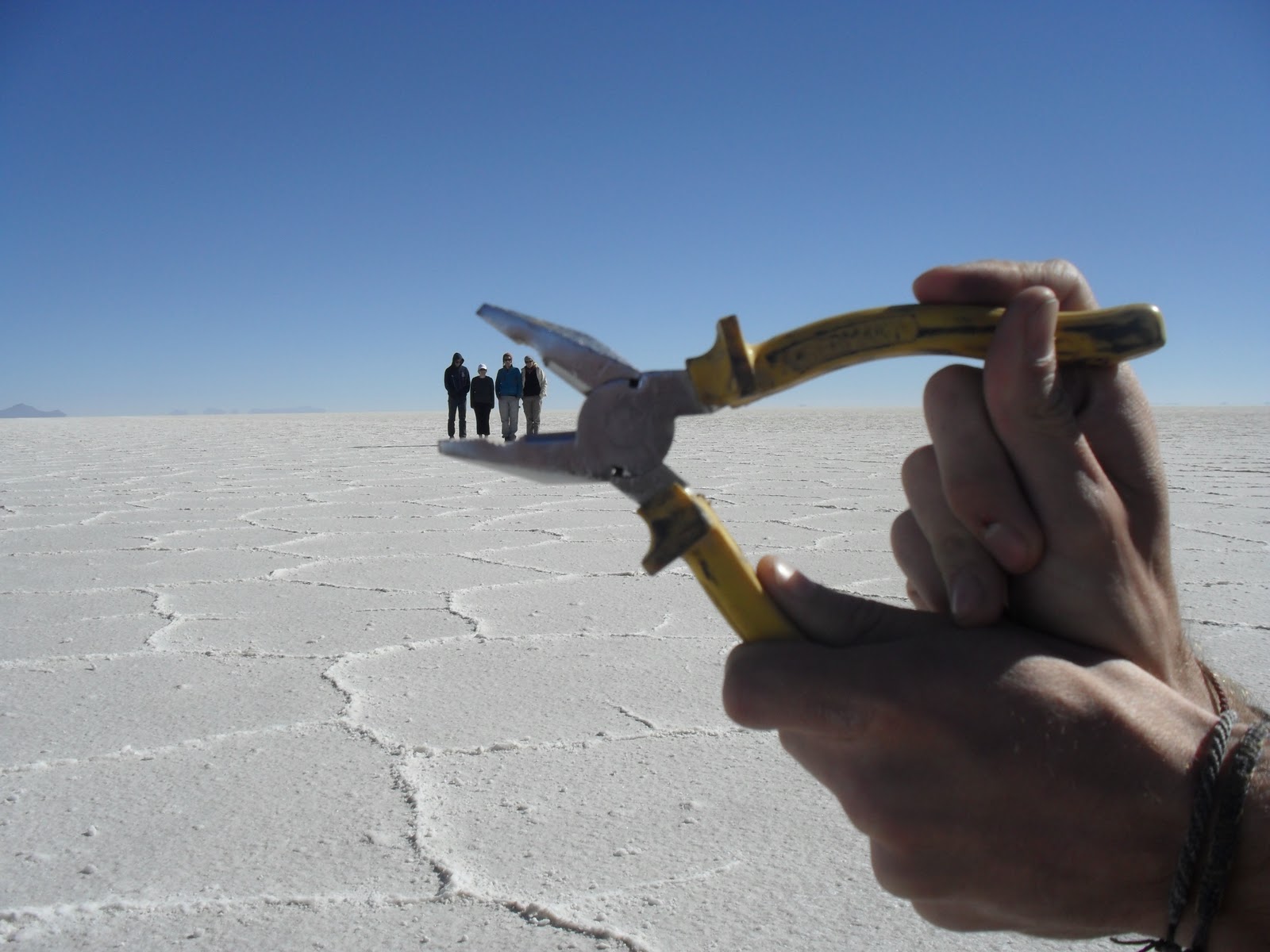
When we got back in the car, we stopped on the other side of the island and took pictures.  The far edge of the Salar was not visible, which proved to be the point.  On a white space without any objects to give the eye perspective, many photographic tricks are possible and we amused ourselves by exploring the possibility for hours.  We had so much time because another 4x4 had broken down, the one that Kev and Alison were on, right where we were set to take pictures and our driver and the other driver for our tour group were helping their driver fix the vehicle.  It took a very long time for them to fix it.
 
So we were a little late since we had decided to wake up for the sunrise and were supposed to be in Uyuni at about midday, we were now on schedule to arrive in Uyuni as if we hadn’t woken up for the sunrise, at about 3pm.  This will prove to be very important.  We sailed across the salar, stopping briefly at a small place with many flags and a village with a market where we bought two small pieces of salt for about 15 cents. 

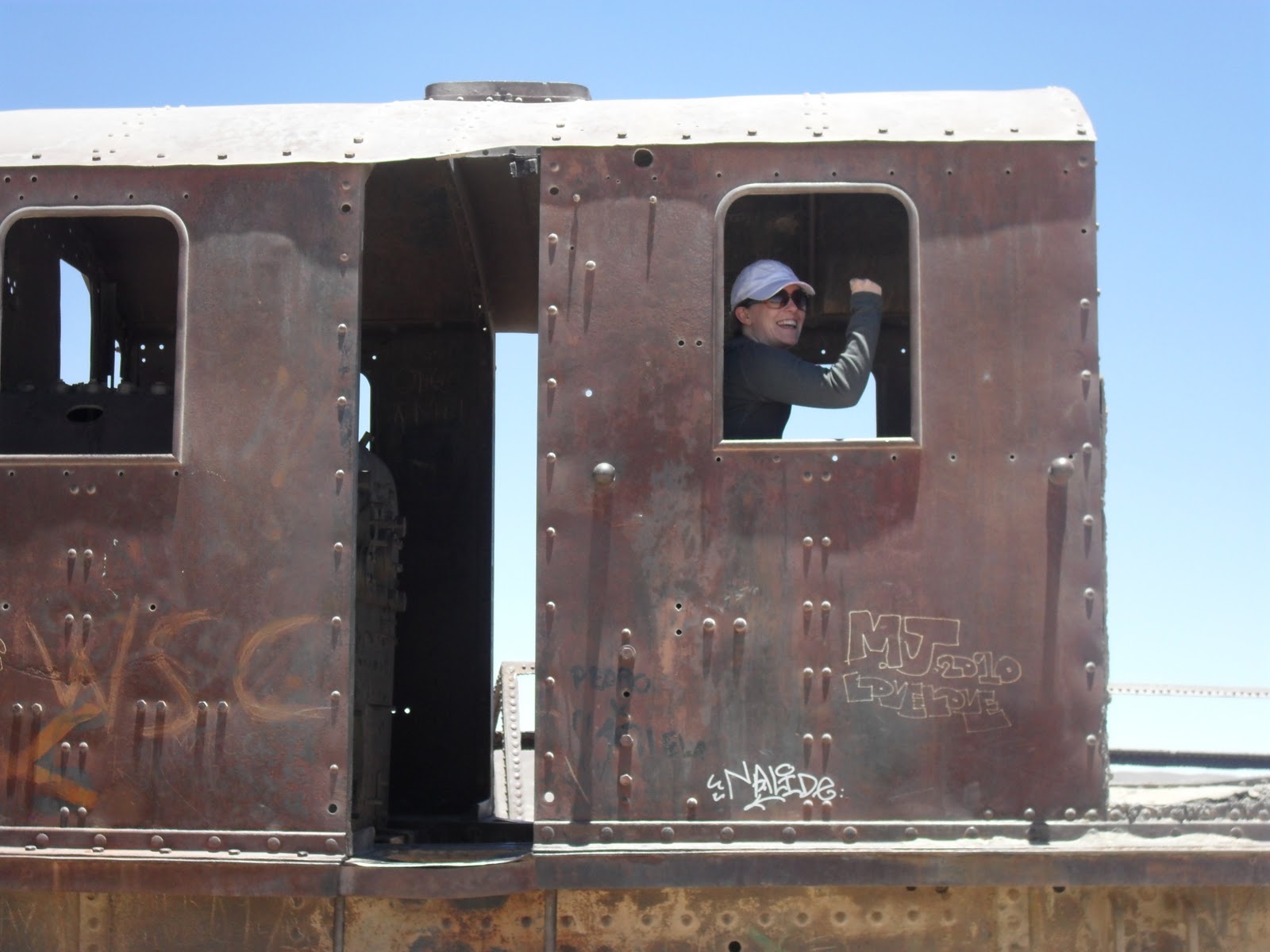
The outskirts of Uyuni are covered in plastic bags blown by the wind and caught on desert brush.  And then you come to the train graveyard, covered in the same trash that covers the desert around it.  The rusty piles of metal resting on warped tracks are the town proper’s greatest attraction.  They’re bizarre and dangerous looking and covered in graffiti that ranges from the banal to the intellectual.   Amanda climbed on them and acted like a train conductor, but I don’t know if I’m still officially immunized for tetanus so I declined.


On to Uyuni, the driver, since we didn’t arrive at a reasonable hour, billed the tour company for lunch at an almuerzo familiar place above the immigration office (bizarre right), which was alright.  It was simple, first quinoa soup, then some meat in sauce and rice.  We went around the corner to check into our hostel, the cheapest place we’ve stayed in, only 14 dollars a night for both of us in a private room sharing a bath.  Then since we were still illegal in Bolivia because we’re shifty Americans and the only nationality that needs a visa which costs 135 dollars to enter the country, we went to the only ATM in town.  No dice.  It’s Saturday.  That means that it won’t be fixed until the bank opens again on Monday.  So instead of heading off to Sucre on Sunday, we were stuck in Uyuni after the immigration officer, who was a very nice man, locked our passports in a safe at the immigration office.  We rested in Uyuni and on Monday when the ATM was fixed there was a line across the street, and we only had an hour to get money, get a visa, and get on the bus to Sucre at 10.  I waited in line, as Amanda went to the immigration office to fill out the paperwork, when I finally got money I sprinted there.  They put our visa in our passports with time to spare and we were off to Sucre after showing off the skills that would make us favorites if we were ever on The Amazing Race.

Sunday, December 5, 2010

The Sweet Life in Sucre


Dan hasn’t completed the last half of our adventures in the desert blog yet, but I thought I’d write a little about what we are doing at the moment.  We are currently in Sucre, Bolivia. We finally got our visas and have been here 13 days. We are staying in an amazing guesthouse (La Dolce Vita or The Sweet Life) in our own little suite.  The owners of the guesthouse are on vacation so we pretty much have the place to ourselves, although there are always some random Germans around (this can never be avoided in South America J ). 

                                                                             We have been spending our days pretending to be independently wealthy. We wake late in the morning, do some light yoga and exercises, then go out for lunch.  In the afternoon we read and watch educational videos (Dan is studying economics).  I usually take a siesta and Dan looks at the interwebs until about 3pm when we get ready for the day and do our homework. At 4:45pm we head to school where we take Spanish classes and teach English until 7pm.  Then we cook dinner and retire to our room to watch TV shows or a movie. Then we cap off the day with Dan reading out loud from “Love in the Time of Cholera” by Gabriel Garcia Marquiz.  To put it simply, it is AWESOME. We have six more days here then we are off to La Paz and making our way to Machu Picchu by December 22.

One note: We have been fairly sickly here, this was to be expected.  My digestion has troubled me from my first day in Bolivia, and Dan for about a week, so we had to do a three day antibiotic regimen.  This appears to have taken care of the problem, and we are hoping to be healthy from here on out, although we aren’t holding our breath!